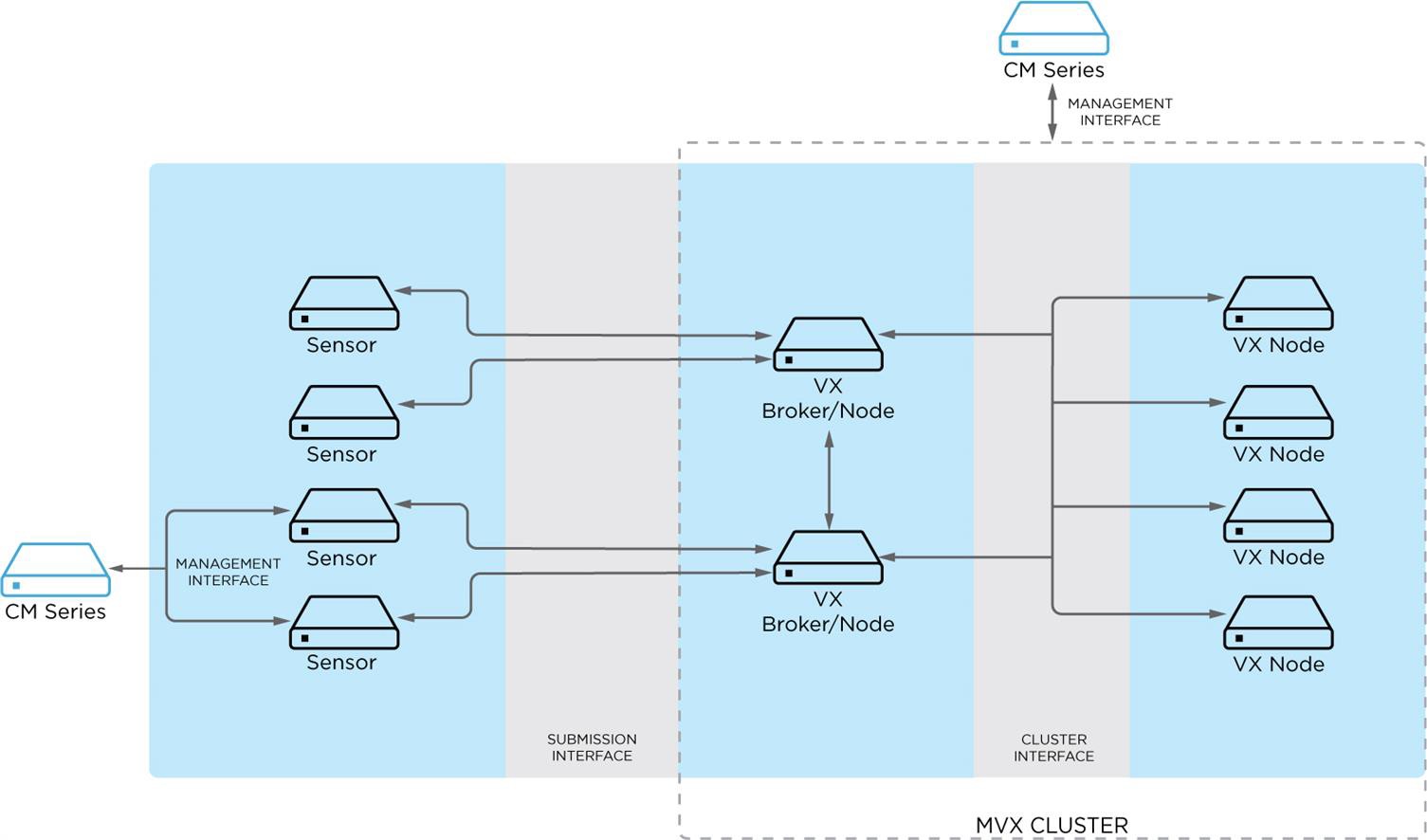
The following diagram shows the communication paths between the IVX cluster components in an MSSP deployment.
During the initial configuration, you can accept the default interfaces provided by the configuration wizard, or you can change them.
Management Interface—In the preceding diagram, the connection between the Central Management appliance in the private cloud and the brokers and nodes is established through the management interface the same way as it is for other managed appliances. By default, both SSH and HTTPS traffic use the SSH port (port 22). The connection between the on-premises Central Management appliance and the sensor is established the same way.
Submission Interface—Sensors and brokers communicate with each other through the submission interface using SSH. The default submission interface is ether1. A second interface (ether2) can also be configured.
Cluster Interface—Brokers and nodes communicate with each other through the cluster interface using SSH and other protocols, secured through TLS (SSL). The default cluster interface is ether1, but another interface (for example, ether2) can be configured instead.
Brokers expose ports 25672 and 4369 for inter-broker communication. They also expose port 5671 for communication with compute nodes. Ports 25672 and 5671 are SSL- encrypted. Port 4369 is protected by key hash. Sensors and compute nodes connect to brokers using SSH (port 22). The cluster database uses TCP port 7001. Cluster management communication uses TCP and UDP ports 18300 through 18303.
Submission traffic from sensors to the broker in the IVX cluster in the private cloud must be exempted from any Web filtering product or man-in-the-middle SSL proxy you have deployed in your network. (The submission interface uses SSH over SSL (port 443); it does not carry HTTPS traffic.)
Note
For deployment steps, see MSSP deployment tasks.