The detection capability from various log sources can be compared with the "cost" (in terms of dollars as well as resources and effort) to form an efficiency curve.
The diagram below provides a prioritized view with the outside ring being the highest priority data to be ingested by Helix Enterprise.
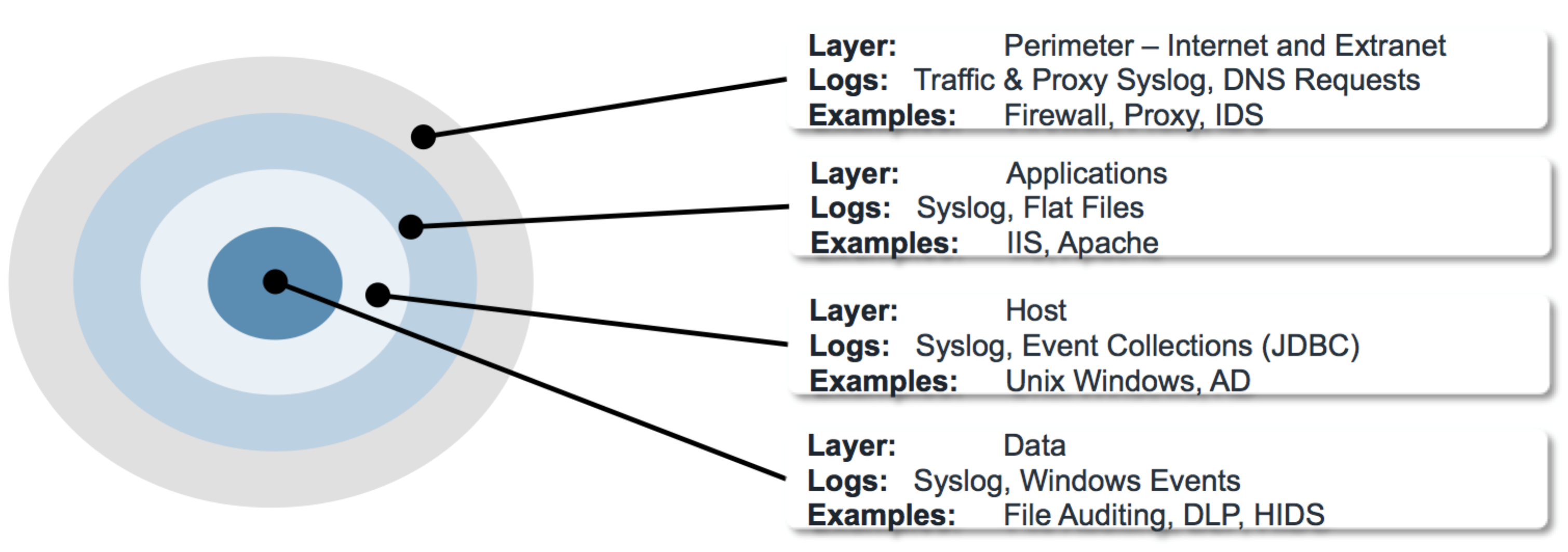
Perimeter devices create a bottleneck for network traffic to the internet and are generally easy to configure for syslog. Perimeter devices such as firewalls translate outside IP addresses to outside Ops and track ports used, providing key information used to identify malware and other activities of known malicious actors. Web proxy events allow detection of beaconing activities and SQL injections.
Operating system logs, including system events and process tracking from high-value systems such as domain controller and logs from DNS, DHCP, and other anti-virus software, offer valuable context into potential malicious activity such as lateral movement.
Data logs such as file auditing, DLP, or file integrity auditing, have less value to security operations compared to other data sources and can be complex to implement effectively.
Event data generated by the following network devices, network services, security devices, and applications help detect advanced threats:
Web applications: IIS, Apache, Tomcat
Authentication sources: VPN, two factor, SSO, AD, LDAP
Network devices: Routers, switches
Network services: DNS, DHCP, NAT
Network sensors: Bro, Npulse, Extrahop
Security devices: Firewalls, IPS, DLP, NAC (Network Access Controls)
Applications: ERP, CRM, Web applications
Email: Server transaction events, filtering, security events
Threat Detection Systems such as Helix Enterprise
Internet devices: Switches, routers, and VPNs such as Cisco, Juniper
Web Proxy: BlueCoat, Websense
Endpoint security: Anti-virus, HIPS, Bit9
Log aggregators: Splunk, Q1, Rsyslog, ArcSight, RSA Envision, Estreamer
Note
JSON structured data file uploads should use port 515.