Endpoint Security intercepts threats, monitors overall system health, and reports detection and status information. Client software is installed on each system to perform these tasks.
Typically, you install one or more Endpoint Security modules on client systems, manage detections, and configure settings that determine how product features work.
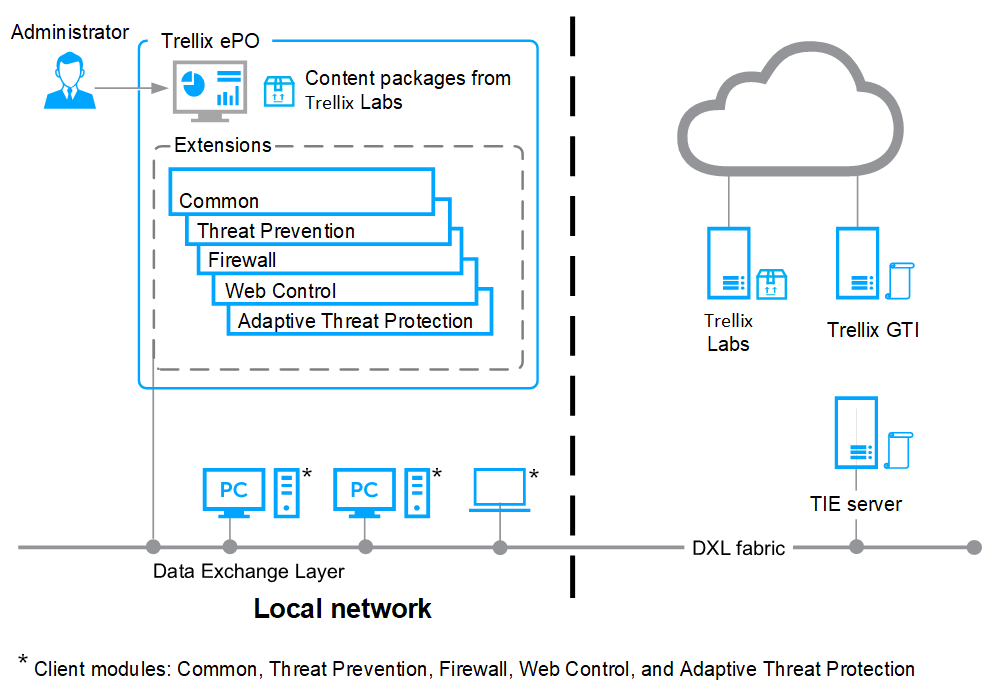
Trellix ePO - On-prem
You use Trellix ePO - On-prem to deploy and manage Endpoint Security modules on client systems.
Each module includes an extension and a software package that are installed on the Trellix ePO - On-prem server. Trellix ePO - On-prem then deploys the software to client systems. Trellix ePO - On-prem.
Using Trellix Agent, the client software communicates with Trellix ePO - On-prem for policy configuration and enforcement, product updates, and reporting.
Client modules
The client software protects systems with regular updates, continuous monitoring, and detailed reporting.
It sends data about detections on your computers to the Trellix ePO - On-prem server. This data is used to generate reports about detections and security issues on your computers.
TIE server and Trellix DXL
The Endpoint Security framework integrates with Trellix Threat Intelligence Exchange (TIE) and Trellix® Data Exchange Layer when using Adaptive Threat Protection. These optional products enable you to control file reputation locally and share the information immediately throughout your environment.
Trellix GTI
Threat Prevention, Firewall, Web Control, and Adaptive Threat Protection query Global Threat Intelligence for reputation information to determine how to handle files on the client system.
Trellix Advanced Research Center
The client software communicates with Trellix Advanced Research Center for content file and engine updates. Trellix Advanced Research Center regularly releases updated content packages.
How your protection stays up to date
Regular updates of Endpoint Security protect your computers from the latest threats.
To perform updates, the client software connects to a local or remote Trellix ePO - On-prem server or directly to a site on the Internet. Endpoint Security checks for:
Updates to the content files that detect threats. Content files contain definitions for threats such as viruses and spyware, and these definitions are updated as new threats are discovered.
Upgrades to software components, such as updates and hotfixes.